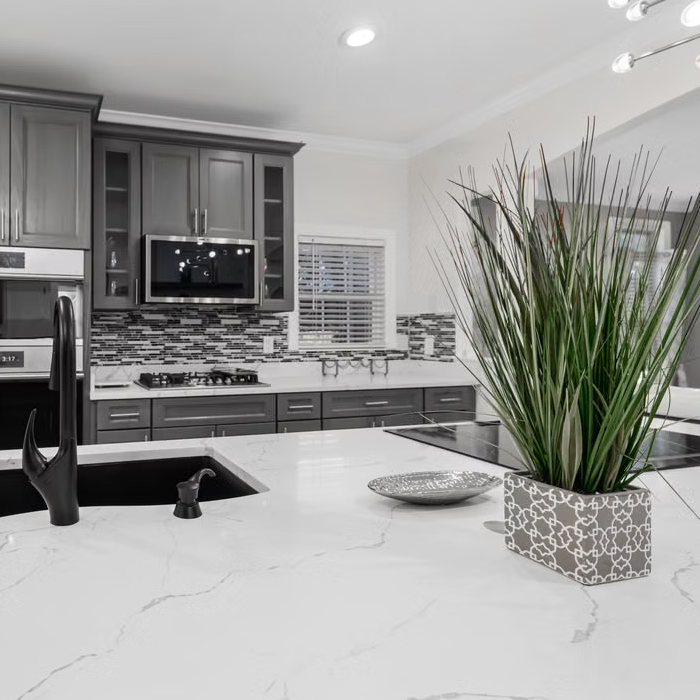
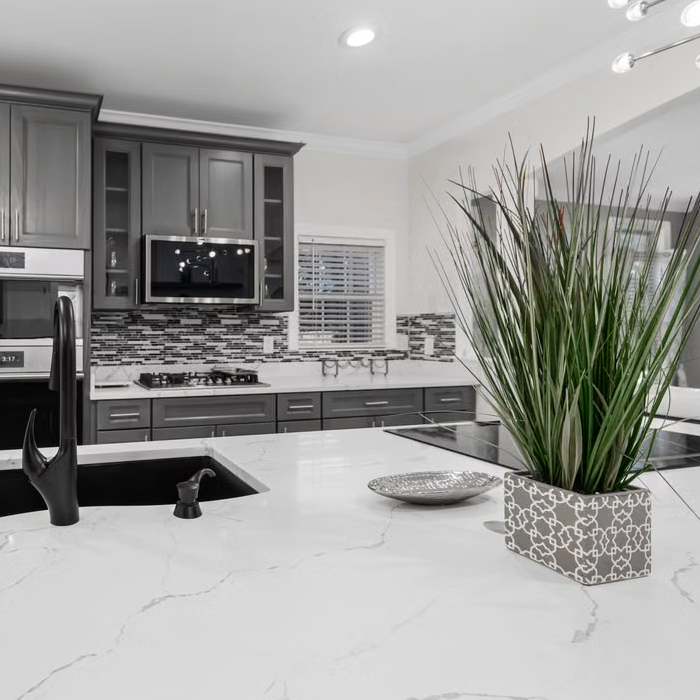
Popular options include quartz, granite, marble, laminate, solid surface, and butcher block, among others. Each material offers a different combination of appearance, durability, maintenance, and price.
The best countertop isn't necessarily the most expensive one. It's the one that fits your lifestyle, budget, design, and maintenance preferences.
Let's take a look at some of the most popular types of kitchen countertops.
What Should You Consider When Choosing a Countertop?
Before choosing a material based solely on appearance, think about how your kitchen is used.
Consider:
For example, a homeowner who cooks every day may have different priorities than someone who primarily uses their kitchen for making coffee and occasional meals.
There isn't one countertop material that's perfect for everyone.
Quartz Countertops
Low Maintenance With a Wide Range of Styles
Quartz is one of the most popular choices for modern kitchens.
Quartz countertops are engineered surfaces made primarily from quartz combined with resins and other materials. Unlike many natural stone countertops, quartz is nonporous, which means it doesn't require routine sealing. It is also resistant to many common stains and relatively easy to clean.
Benefits of Quartz
Quartz is particularly appealing if you want the look of stone without the maintenance associated with some natural stone surfaces.
Things to Consider
Quartz isn't completely maintenance-free.
Although quartz is durable, excessive heat can damage the material, so hot pots and pans should be placed on a trivet or heat-resistant surface rather than directly on the countertop. Some quartz products can also be affected by prolonged UV exposure.
Quartz may be a good fit if: You want a durable, low-maintenance countertop with plenty of design options.
Granite Countertops
Natural Stone With One-of-a-Kind Character
Granite has been a popular countertop material for decades—and for good reason.
Because granite is natural stone, every slab has its own variation in color, pattern, and veining. That means your countertop can have a genuinely unique appearance.
Granite is also known for its resistance to heat and scratches. When properly sealed and maintained, it can also resist stains and moisture.
Benefits of Granite
Things to Consider
Granite generally requires more maintenance than a nonporous material such as quartz.
Depending on the specific granite and sealer, periodic resealing may be necessary to help protect the surface from staining.
Granite can also be heavy, and repairing significant damage can be difficult.
Granite may be a good fit if: You love the natural variation of stone and want a durable countertop with a distinctive appearance.
Marble Countertops
Classic, Elegant, and Naturally Unique
Marble is known for its distinctive veining and timeless appearance.
It's a popular choice for homeowners who want their kitchen to have a high-end, natural-stone look.
However, marble requires more consideration than some other countertop materials.
Marble is softer and more susceptible to scratching and etching than many countertop alternatives. It can also be vulnerable to staining if it isn't properly cared for.
Benefits of Marble
Things to Consider
Marble is better suited to homeowners who are comfortable with a material that can develop signs of use over time.
If you're looking for a countertop that will look exactly the same years from now with minimal maintenance, another material may better fit your expectations.
Marble may be a good fit if: You prioritize natural beauty and character and don't mind some maintenance and signs of everyday use.
Laminate Countertops
An Affordable Way to Transform Your Kitchen
If budget is one of your biggest considerations, laminate is worth a look.
Modern laminate countertops are available in a huge variety of colors, patterns, and finishes. Some can even replicate the appearance of natural stone or wood.
Laminate is also relatively easy to clean and generally requires little routine maintenance.
Benefits of Laminate
Things to Consider
Laminate isn't as resistant to heat or scratches as some stone surfaces.
Hot cookware should not be placed directly on laminate, and sharp objects can damage the surface.
Laminate may be a good fit if: You want to update your kitchen's appearance while keeping the countertop project more budget-conscious.
Butcher Block Countertops
Warm, Natural Character
Butcher block can bring a completely different look to a kitchen.
Instead of the cool appearance of stone, wood countertops provide warmth and natural texture. They're especially popular for kitchen islands, breakfast areas, and spaces where homeowners want to create a focal point.
Another advantage is that minor scratches and nicks can often be sanded out and refinished.
Benefits of Butcher Block
Things to Consider
Wood countertops require more maintenance than many stone alternatives.
Depending on the finish and intended use, butcher block may require regular conditioning or treatment to help protect it from moisture. Excessive heat and very dry conditions can also contribute to damage.
Butcher block may be a good fit if: You want a warm, natural countertop and don't mind putting a little more effort into maintenance.
Solid Surface Countertops
Seamless and Versatile
Solid surface countertops are manufactured surfaces that can provide a clean, consistent appearance.
One advantage of solid surface is the ability to create designs with fewer visible seams, depending on the installation. Solid surface is also nonporous and easy to clean.
Benefits of Solid Surface
Solid surface can also be useful if you're looking for a countertop and sink combination with a particularly clean, integrated appearance.
Solid surface may be a good fit if: You want a low-maintenance surface with a clean, streamlined appearance.
Porcelain Countertops
Modern Style and Durability
Porcelain is another countertop material worth considering, particularly for homeowners looking for a contemporary surface.
Porcelain countertops are available in a variety of colors and patterns and can be manufactured to replicate the appearance of natural stone and other materials.
Because countertop products can vary significantly by manufacturer, it's important to review the specific product's performance characteristics and installation requirements before choosing porcelain.
Porcelain may be a good fit if: You're looking for a modern countertop with a wide range of design possibilities and want to explore alternatives to traditional stone.
Quartz vs. Granite: What's the Difference?
Quartz and granite are two of the most commonly compared countertop materials.
The biggest difference is that granite is natural stone, while quartz countertops are engineered surfaces.
Feature | Quartz | Granite |
Material | Engineered | Natural stone |
Appearance | Consistent patterns available | Naturally unique patterns |
Maintenance | Low | Periodic sealing may be needed |
Stain resistance | Nonporous | Depends on sealing |
Heat resistance | Can be damaged by excessive heat | Highly heat resistant |
Scratch resistance | High | High |
Design options | Extensive | Natural variations |
Neither material is automatically right for every kitchen.
Your decision may come down to whether you prefer the consistency and low maintenance of quartz or the natural variation and character of granite.
What Is the Most Low-Maintenance Countertop?
If minimal maintenance is your priority, nonporous surfaces such as quartz and many solid-surface countertops are worth considering.
These materials generally don't require the routine sealing associated with some natural stone surfaces and can typically be cleaned with mild soap and water.
That doesn't mean they are completely maintenance-free. You should still follow the care instructions provided by the manufacturer.
What Is the Most Affordable Countertop Material?
If you're working with a tighter budget, laminate is generally one of the most affordable countertop options.
It also gives you a surprising amount of flexibility when it comes to colors and patterns.
Modern laminate can replicate the appearance of more expensive materials, allowing you to create a specific design without necessarily choosing natural stone.
Your final cost will depend on factors such as the size of your kitchen, countertop material, edge profile, sink cutouts, backsplash, installation, and other project requirements.
What Is the Most Durable Countertop?
Durability depends on what you're trying to protect against.
A countertop that is highly resistant to scratches may not have the same heat resistance as another material. A surface that's easy to repair may require more maintenance.
For example:
Think about the types of wear your countertops will experience rather than looking for a single "most durable" material.
Can You Mix Countertop Materials?
Absolutely.
You don't necessarily have to use the same countertop material throughout your kitchen.
For example, you could use one material around the perimeter of the kitchen and a different material on the island.
This can create visual contrast while also allowing you to choose materials based on how different areas of your kitchen are used.
For example, a homeowner might choose a stone surface for the main cooking area and a wood surface for an island to introduce warmth and contrast. Using different surfaces for different work zones is one approach to creating a more customized kitchen.
How Do You Choose the Right Countertop Color?
Once you've narrowed down your material, you still have another major decision: color.
Your countertop should work with the other major finishes in your kitchen, including:
Don't forget to consider your flooring when selecting countertops.
Your countertops and floors don't have to match, but they should complement one another.
If your flooring has a strong pattern or noticeable variation, a more subtle countertop may create balance. Conversely, simple flooring can give you more freedom to make your countertop a focal point.
Don't Forget About the Countertop Edge
The countertop material isn't the only design decision.
The edge profile can also affect the overall appearance of your kitchen.
Common options include:
The options available can vary depending on the countertop material.
A simple eased edge can create a clean, contemporary appearance, while a more decorative profile can complement a traditional kitchen.
So, Which Countertop Material Is Right for Your Kitchen?
The answer depends on how you use your kitchen and what matters most to you.
Choose Quartz If You Want:
Choose Granite If You Want:
Choose Marble If You Want:
Choose Laminate If You Want:
Choose Butcher Block If You Want:
Choose Solid Surface If You Want:
Choose Porcelain If You Want: